In 2021, the idea of an alternative bicycle drivetrain was put forward in a Mechatronics class group chat at the University of Canterbury. This garnered moderate interest and those involved realised there was enough interest to start a student club focussed around cycling technology.
Over the university summer break (November to early February in New Zealand) while the students were spread around the country doing summer internships, there were a number of video calls to get the club going for 2022. The plan was to do some research, experiments, support personal projects and start “Project 100” – to break New Zealand’s open road speed limit of 100 km/h, inspired by what had been seen of teams at the World Human Power Speed Challenge. The first step of Project 100 was to carry out initial research of aerodynamic, chassis and drivetrain considerations. Learning of the challenges ahead, the club set out with the first goal to produce a recumbent tricycle that would be suitable for anyone to try riding. At that stage none of us had tried riding a recumbent nor know of anyone with a recumbent!
Founding Members
To officially form the club we held an IGM online in the evening of the 17th January 2022 with attendance of: Rohan Mathias, Daniel Rickerby, Matthew McHugh, Matthew Walker, Ryan Walker, Zoe Sharp, Daisy Forsythe, Caelum Betteridge, Lucy Thomson and Gian Padrutt
Also at the beginning we had encouragement and support from: Ethan Langton, Laylin Van der Merwe, Luke Peters, Obadiah Greening-Christian (original club treasurer) & Samrath Sood. Along with support from Mechanical Engineering staff including: Bruce Robertson, Daniel Bishop, Digby Symons and Gary Cotton.
By January 2022 the club had agreed to go ahead with producing a trike and try something less conventional with a tilt steer delta trike, following the example of the Mosquito. The design allows for a compact front wheel drive system and front wheel steering with its 4-bar linkage at the rear. There was hope that this design might lead to a novel linkage steering mechanism which could be used in a future speedbike (funnily enough it didn’t, as with most things in cycling, they have been done before!).

On our shoe string budget, the materials we used were:
- the rear triangle, drivetrain and front wheel from an aluminium frame Schwinn children’s bike from our local tip shop, the Ecoshop,
- four bottom brackets and seat tubes harvested at the Aranui Bike Fix Up,
- a treated fence post to create the linkage structure which we could be easily replaced for different geometries,
- mild steel tube and plate to make the frame and wheel mounts,
- eye bolts and paracord for steering,
- an extra 20″ front wheel to complete the tricycle.
We built it over a few group sessions in the student training workshop, which involved learning for ourselves some of the practical basics of bike building and assembly. This included how to remove square taper cranks (with a crank puller not brute force..), how to jig a tubular frame and pin joining the steel frame onto the aluminium front triangle. It was briefly ridden, with improvements identified of having a self-centering mechanism and shortening of the frame to fit a riders proportions.
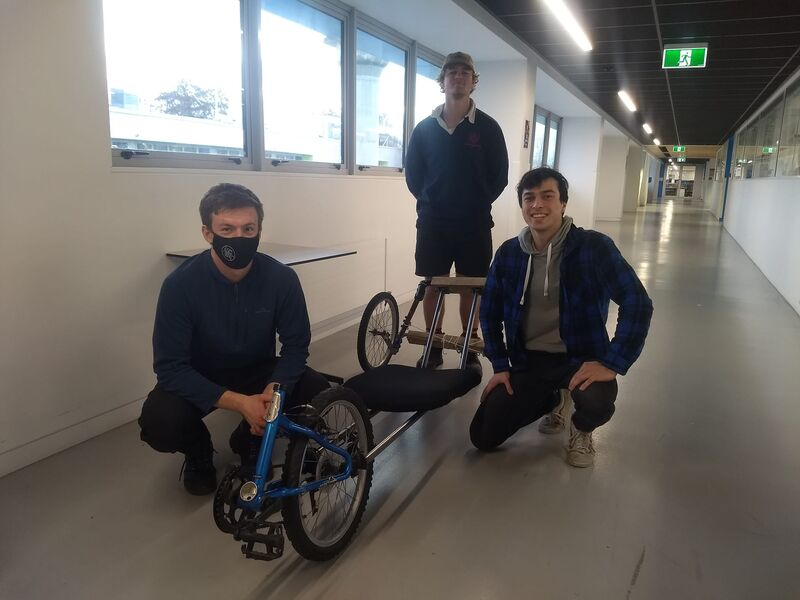
This provided us students with experience in designing and building a dynamic model, providing a project to grow interest and engagement around for moving forward.
Within the University of Canterbury we have followed the tradition of starting an applied technical club with the support of the Mechanical Engineering Department and other external organisations. Our sibling clubs include: UC Aerospace, UC Biomed, UC Flight Club UC Motorsport and UC Robotics.

Other Projects at UC
When UCHP was forming there had been some related projects happening at the university:
Shell Eco-marathon
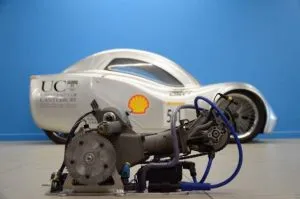
A student team at the university, the EnduroKiwis, competed in the 2017 and 2018 Shell Eco-marathon (Asia), racing in Singapore. The cars were built in the year leading up to the competitions taking place in March, with a focus on on energy efficiency and environmental sustainability.
The 2017 car was the universities first entry in the international competition which has been running since 1939. The car was battery electric and won the UrbanConcept class vehicle design award for its ‘world first’ fully recyclable body from vacuum-formed thermoplastic. Weighing around 130 kg, producing up to 5 kW of power from its battery pack, and reaching speeds of 40 km/h. The team including Reuben Audley (Team Leader), “Chief Pilot” Frank Sullivan, S. Morris, J. Walters, S. Yio and three or four others. The students studying one of Electrical and Electronic, Mechatronics, or Mechanical Engineering. The project carried out under the UCM framework.
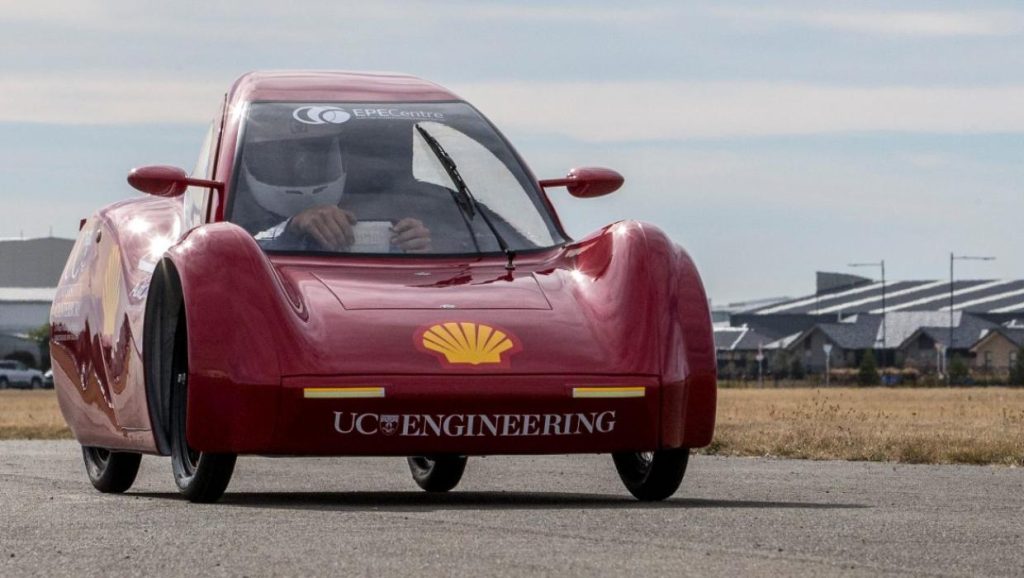
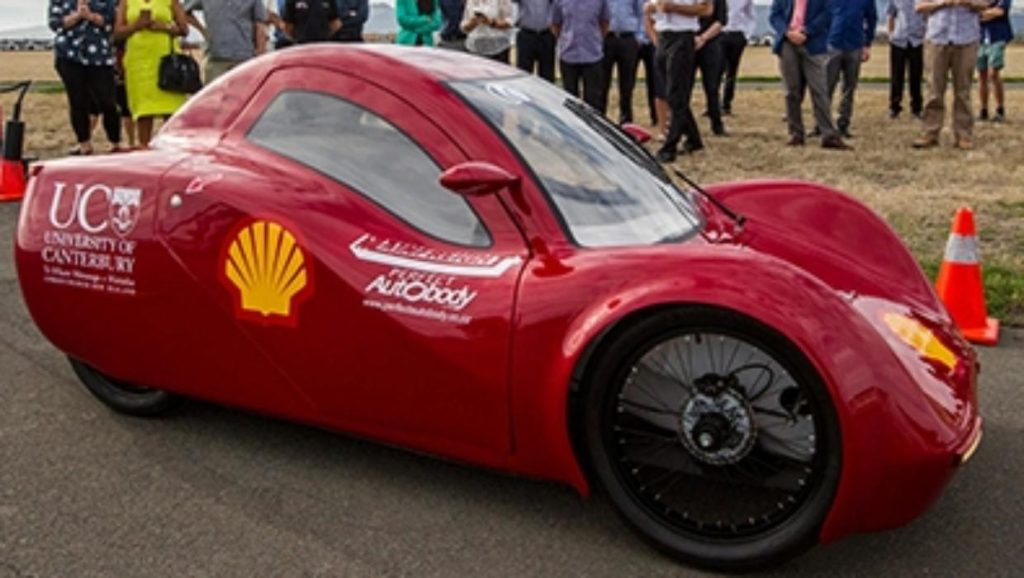
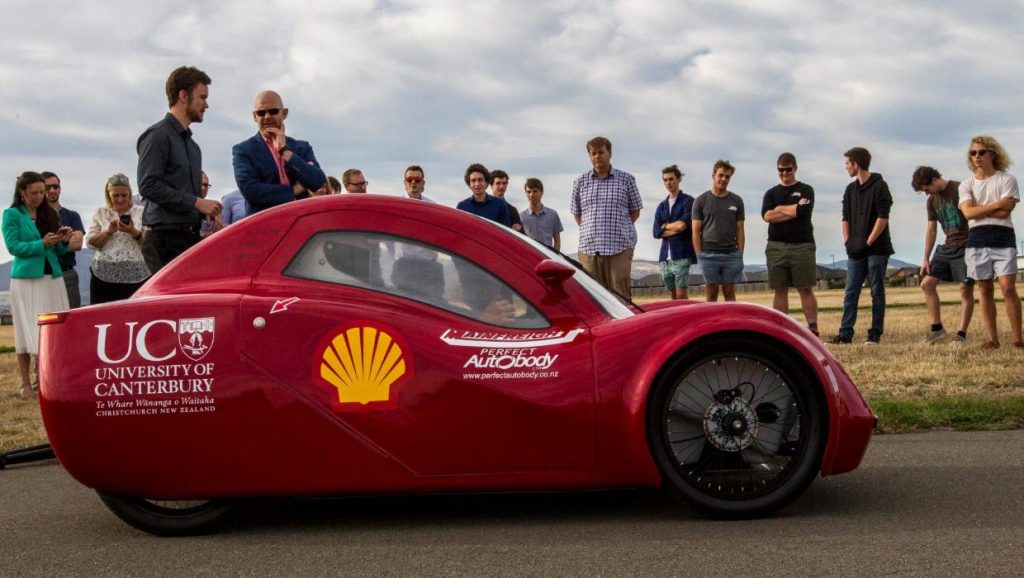
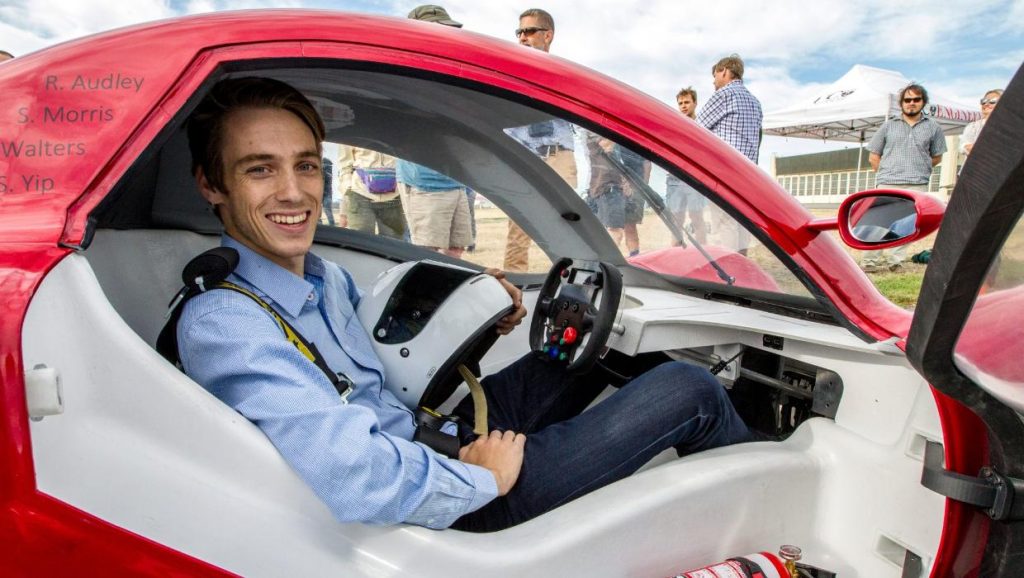
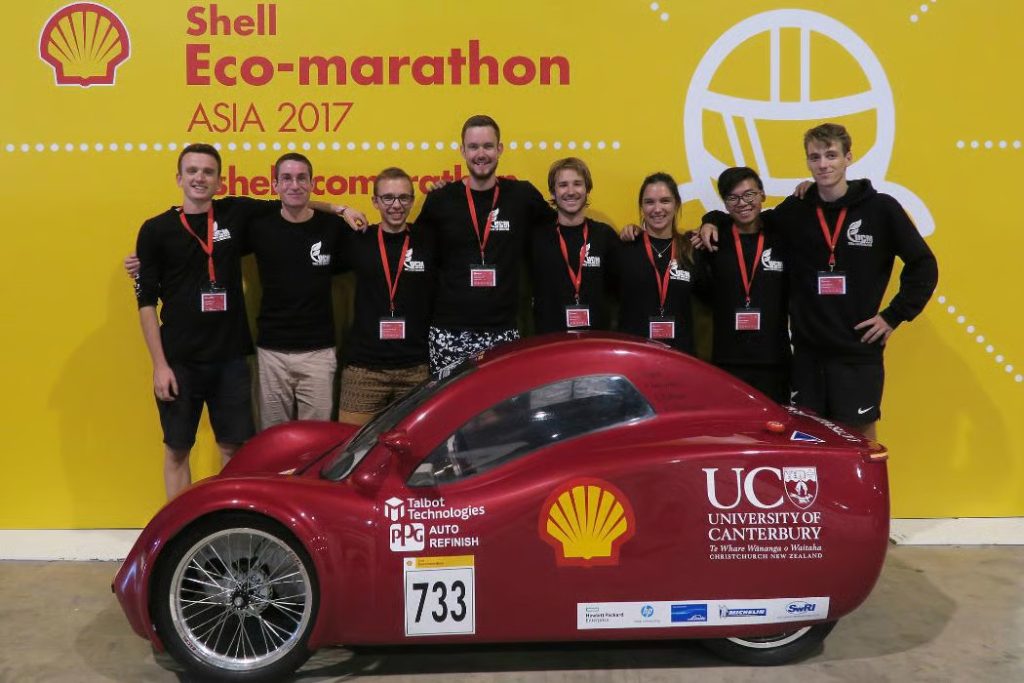
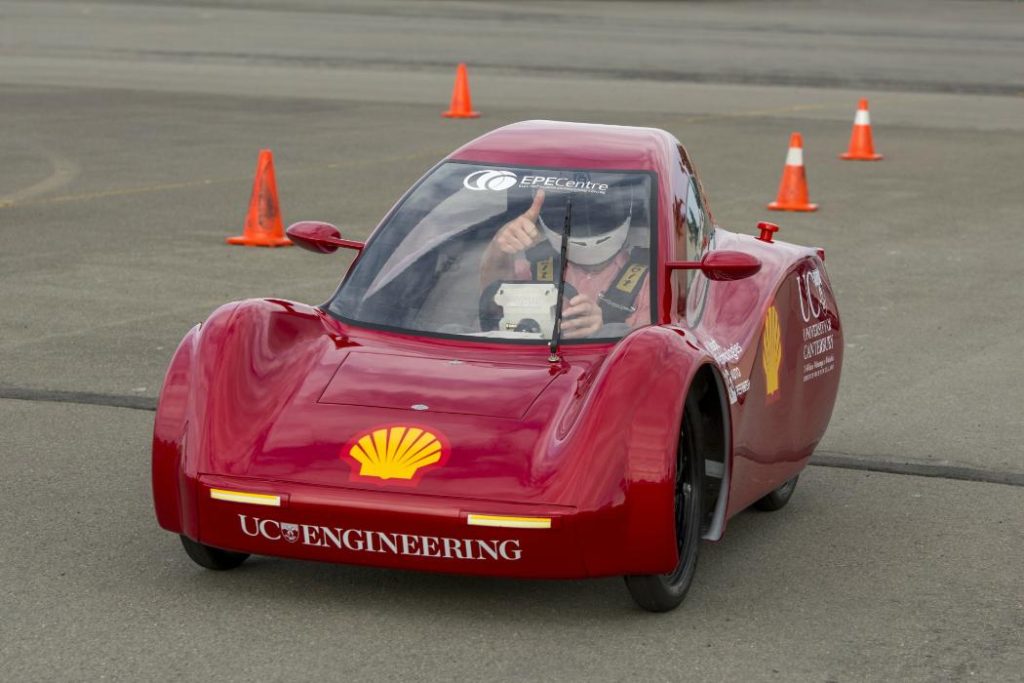
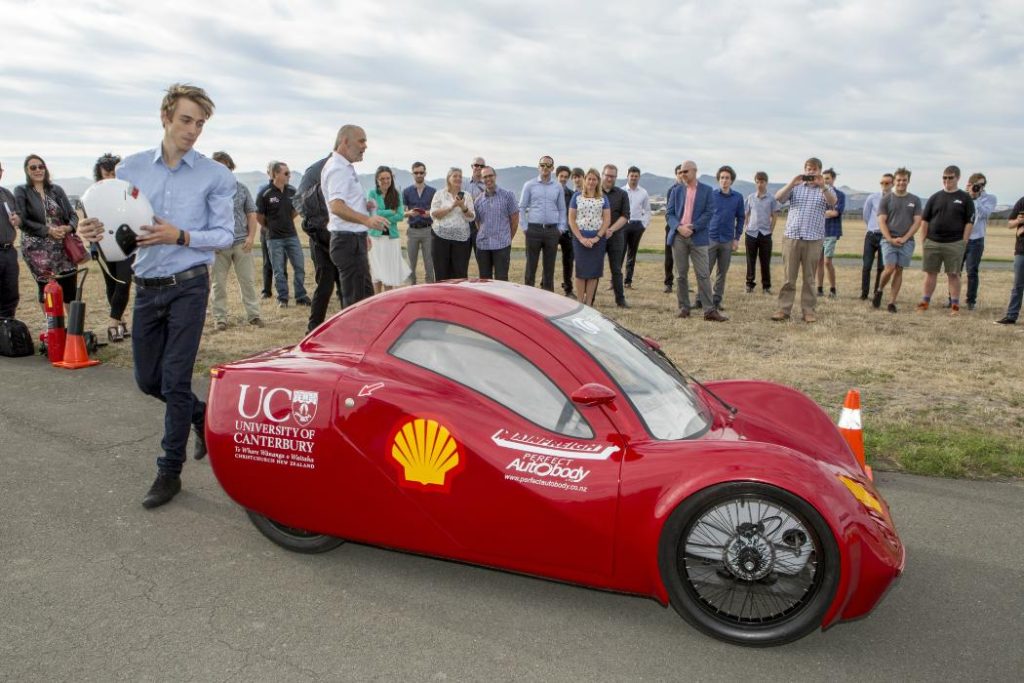
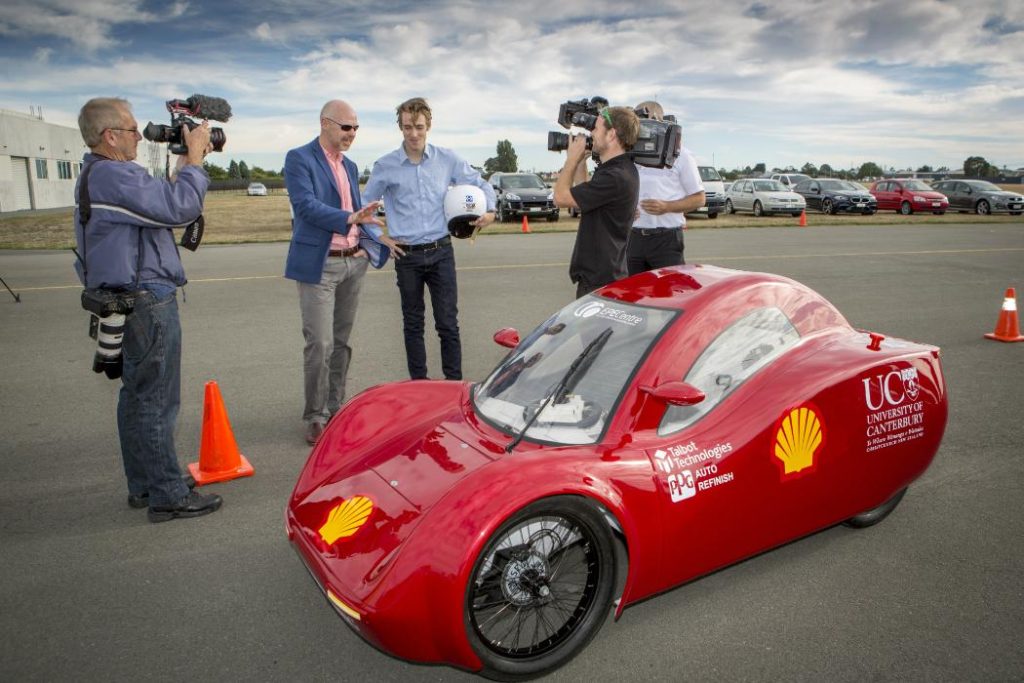
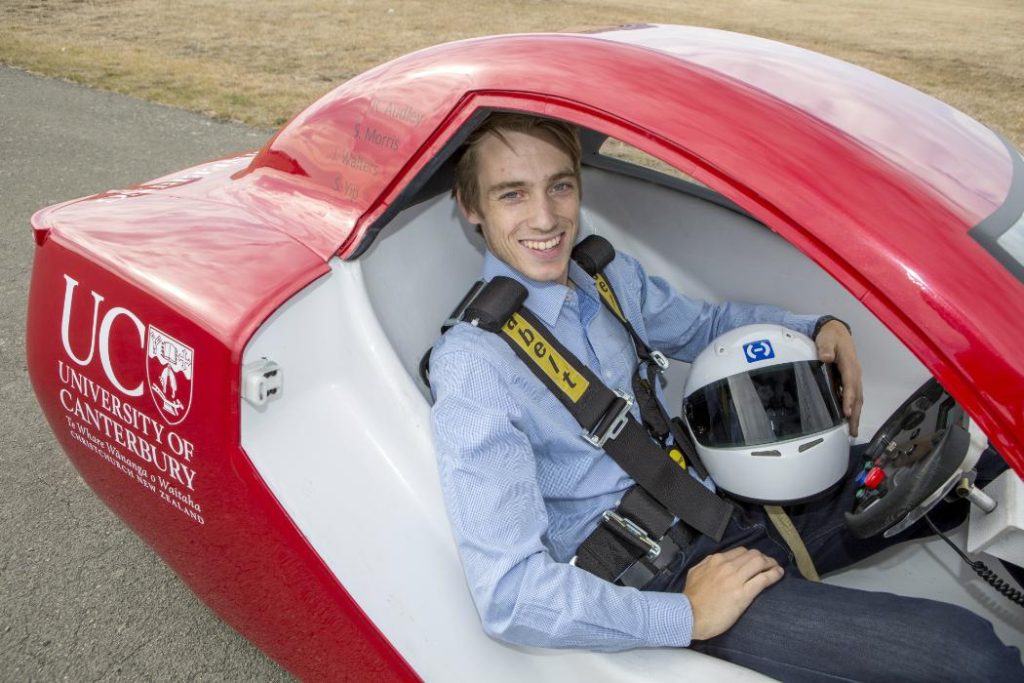
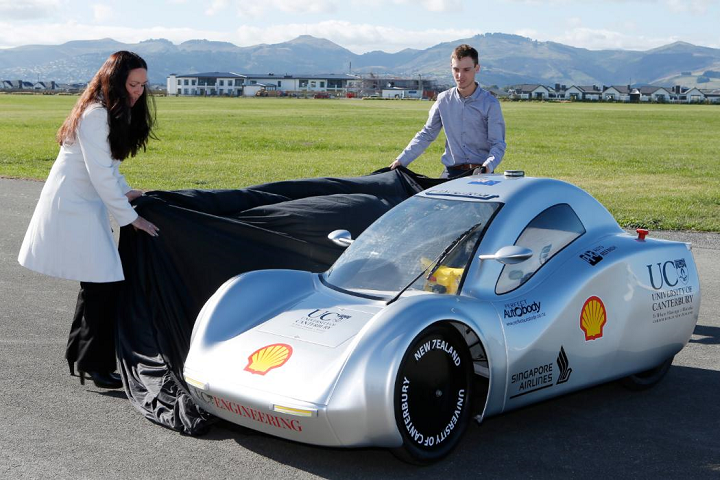
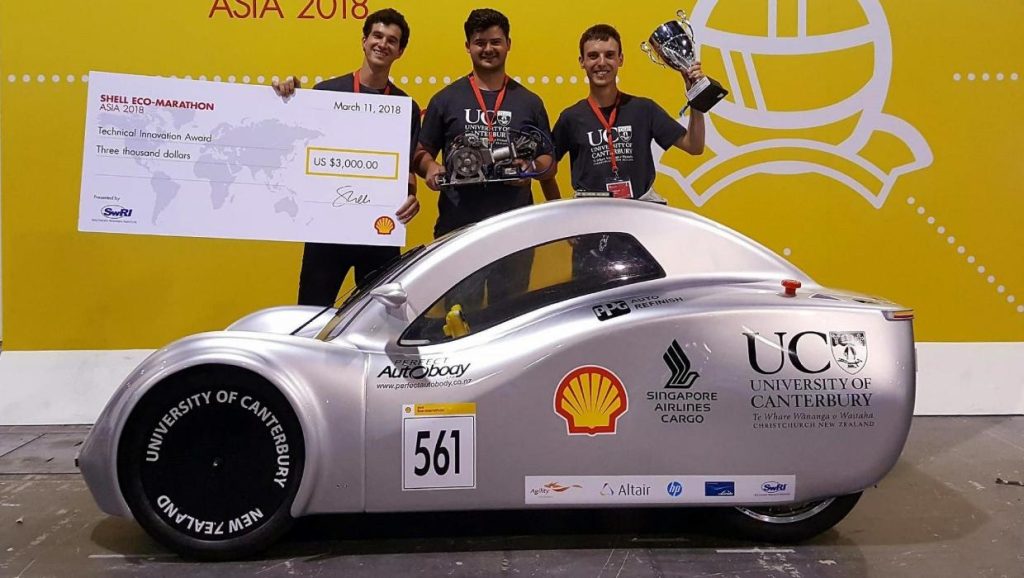
The 2018 entry used the same thermoplastic body but was powered by another ‘world-first’ 3D-printed titanium engine running on ethanol. The single cylinder engine had a fuel economy of about 400 km per litre of fuel. The team was awarded the Technical Innovation Award for the engine. The car was unveiled by UC Engineering Pro-Vice-Chancellor Professor Jan Evans-Freeman and the Eco-marathon student driver, Ben Murton. The team was lead by Robbie Murray.
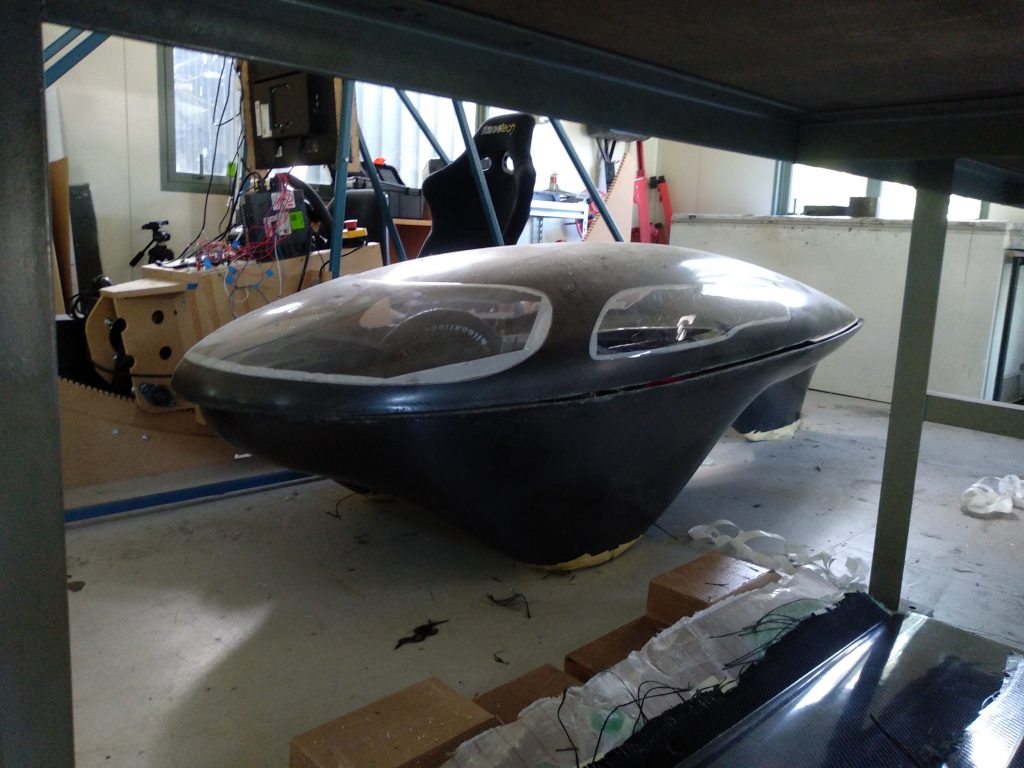
Another chassis was produced in 2019 or 2020 using carbon fibre which was stored in the Kirkwood Workshop through 2021 before being disposed of early 2022. I considered if it could be repurposed into a HPV, but there was not enough space for a rider to pedal a crankset.
The teams were mentored by UC Design Engineer Bruce Robertson
Sources
2017
- https://epicinnovation.co.nz/canterbury-university-team-charged-for-their-world-first-electric-eco-car-marathon-in-recyclable-car/
- https://www.scoop.co.nz/stories/SC1703/S00051/uc-eco-marathon-team-wins-international-design-award.htm
- https://www.stuff.co.nz/motoring/news/90017274/canterbury-university-team-charged-for-their-worldfirst-electric-ecocar-marathon-in-recyclable-car
- https://www.stuff.co.nz/motoring/news/90608986/design-award-for-endurokiwis-at-singapore-shell-ecomarathon
- https://www.facebook.com/DepartmentOfElectricalAndComputerEngineering/posts/1352447228152155/
- https://www.facebook.com/UCMechanical/posts/congratulations-to-the-endurokiwis-for-winning-the-prestigious-design-award-at-t/1852308054981154/
2018
- https://all3dp.com/university-canterbury-3d-print-titanium-engine/
- https://3dprint.com/204950/3d-printed-eco-marathon-engine
- https://www.scoop.co.nz/stories/SC1802/S00052/students-create-world-first-3d-printed-titanium-engine.htm
- https://www.stuff.co.nz/motoring/102257375/kiwis-win-again-in-student-motoring-ecomarathon
- https://www.facebook.com/universitycanterbury/posts/massive-congrats-to-uc-engineerings-endurokiwis-team-who-were-awarded-the-techni/1693638114053436/
- https://www.nzherald.co.nz/business/university-of-canterbury-students-create-world-first-3d-printed-titanium-engine/MPVWJ6JFIU635LHP2FDPOCBNAM/
- https://engineeringnews.co.nz/2019/05/23/university-of-canterbury-showcasing-innovation-at-southmach/
UC Solar Team
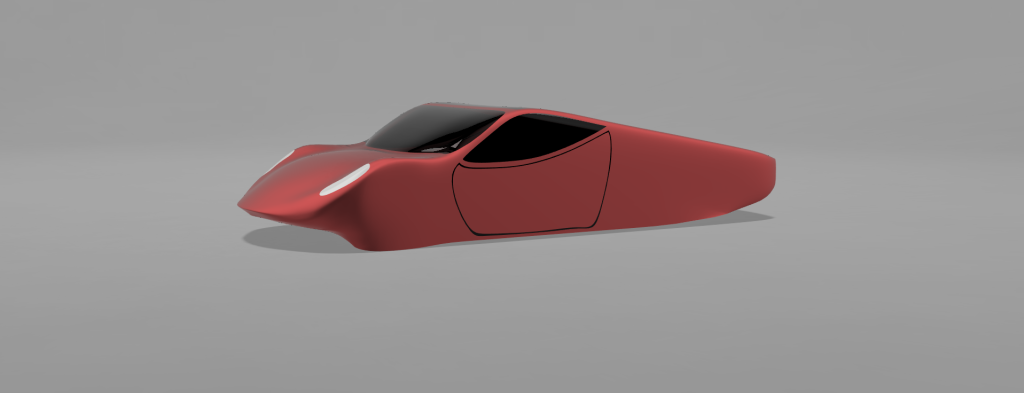
A team existed from 2019 into the beginning of 2020 to design and build a solar car to compete at the biannual 2021 Bridgestone World Solar Challenge. A 3000 km solar powered trip from Darwin to Adelaide. They planned on being the first New Zealand team to compete in the Cruiser class “designed to carry multiple occupants and be a practical alternative to vehicles on the road today”. Also being the first tertiary team from the country. They had over 50 students involved in the planning stage, but unfortunately due to the COVID-19 pandemic and subsequent cancelling of the event, the team dissolved before a vehicle materialised. The intention had been to have a central drivers seat and a composite body using natural fibres.

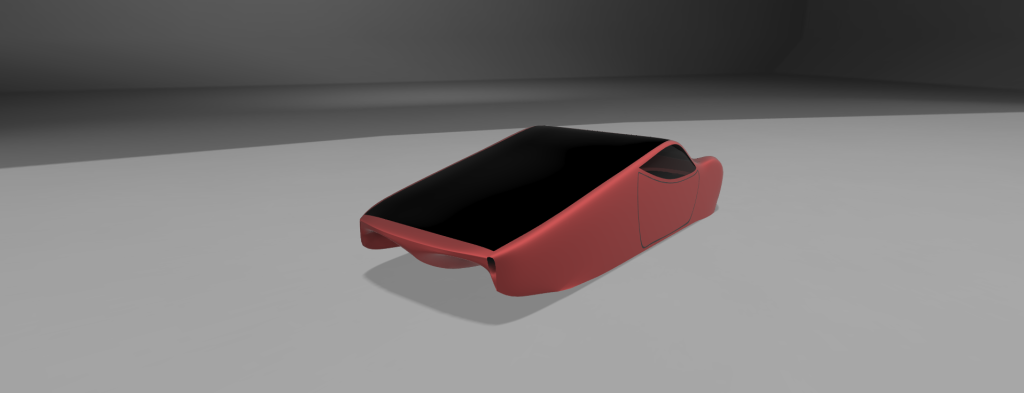
Custom E-trike
In 2021, a final year project was run to produce an electric trike for a local man, Blair Nevin, with cerebral palsy. The story being picked up by TVNZ’s Seven Sharp. Archived article
UCM35 – World E1 Land Speed Record Attempt
The COVID-19 pandemic interrupted the regular cycle of FSAE competitions that the UC Motorsport team competes in. Due to already having a completed car ready for the next competition (see the UCM FSAE cars here), in 2022 the team went about building an electric land speed car to attempt the E1 world record (electric car under 500kg). The project was inspired by the 2005 film The World’s Fastest Indian, which tells the story of Burt Munro who since 1967 has held the record in the 1000cc Streamliner Modified Fuel category (296.2593 km/h). With support from the Munro family, the car was finished with red, black and gold livery and Burts race number 35. They unveiled the car in November 2022 and tested it up to around 120 km/h on what remains of the runways at the local Wigram Airforce Base (now a national museum).
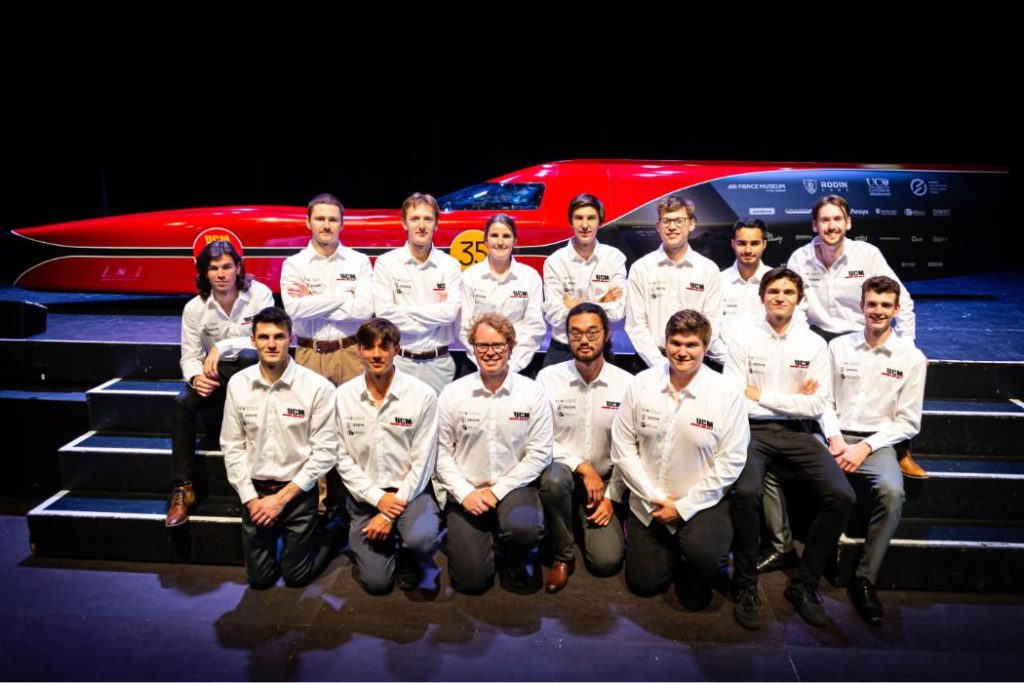
They had intended to ship the car (which can be split into two parts for transport) to South Australia to compete in Dry Lakes Racers Australia Speed Week at Lake Gairdner in March 2023 (in both the E1 and E2 (500-1000 kg) classes by adding some mass), but that did not eventuate. Due to its extreme proportions (~0.8 m wide and 8 m long) it is unsafe to operate at high speed on the roads in New Zealand used for land speed racing. It could be run on a full size runway, likely at either RNZAF Base Ohakea (2447 m) or RNZAF Base Auckland-Whenuapai (2031 m) due to not being commercial runways. On these lengths of tarmac, the car will not be able to reach its top speed but was expected to be able to break the standing world record of 329 km/h (204.9 mph, set by Brigham Young University, USA, in 2014, improving a previous record set with the same car in 2011 (the only other university to have built an electric land speed car)). The car remains unproven.
Articles
- https://www.canterbury.ac.nz/news-and-events/news/2022/students-aim-for-world-speed-record-in-custom-built-electric-car
- https://www.1news.co.nz/2022/11/30/canterbury-students-chasing-land-speed-record-with-custom-ev/
- https://evolocity.co.nz/blog/2022/12/05/university-of-canterbury-motorsport-chasing-ev-land-speed-record/
- https://www.instagram.com/p/ClUs0KLtHk3
- https://news.byu.edu/news/byu-electric-car-breaks-200-mph-barrier-set-new-land-speed-record
Continue reading the story with Part 2 on the beginning of the final year project and the creation of a Proof-of-Concept bike.

Leave a Reply