There is frequently an intellectual interest in recumbents and HPV’s and projects occur at many universities around the world. This is a list of projects I have come across around the world.
Sorted by country alphabetically
Australia
Macquarie University – MQ Speed
Macquarie was the first university to send a team to Battle Mountain, Nevada, attending the 2017 Challenge with (University article). Vehicles built:
- MQ1 – attended the 2017 Battle Mountain event (first Australian University team to do so) (University article)
- MQ2 (University article)
Monash University – Monash Human Power
Canada
ÉTS Montréal – Véloom ETS
An engineering student club that since 2021 they have been working on their vehicle AEROO, a front wheel drive tadpole velomobile with full suspension. Having taken part in multiple ASME HPVC events as both a HPV and with electric assist, achieving a top speed of 74.2 km/h without assistance.
More about the team can be found on their website and Instagram.
University of Toronto Human Powered Vehicle Design Team
Affiliated with the world record holding Aerovelo team that collaborated with the university. Jo Koga is professor at the university and is the clubs faculty advisor. He is most well known in the community for being a key time keeper for Battle Mountain event (Jo’s blog).
Current projects include:
- Typhoon – their latest generation of streamlined bike
- Watercraft – seeking to build a craft to break 20 knots
- Riding and refining their older machines including Cyclone and Tempest
The teams history is covered in their universities wiki: https://skulepedia.ca/wiki/University_of_Toronto_Human_Powered_Vehicle
France
IUT Annecy – Vélo Altaïr
https://www.instagram.com/velo_altair
Italy
Policumbent
Netherlands
From 2010-2020 Delft was active with land speed racing, holding some world records along the way.
New Zealand
University of Auckland
UAC human powered aircraft, based on the Airglow aircraft.
University of Waikato
Low racer recumbent seen on a poster from the 2000’s
University of Canterbury
My alma mater, while I was studying their I helped form UCHP and came across other projects in the past, primarily under the Mechanical Engineering Department.
UCHP
University of Canterbury Human Power club was formed at the end of 2021 by a group of students looking to do projects related to cycling technology. This came together as developing land speed racing streamlined HPV’s. Primarily carried out by final year students as their capstone project, with a new team of 9-11 students with some club member involvement.
- Maroro, a streamlined camera bike built over 2023-24.
- Mako, a streamlined tadpole trike produced in 2025. Development started at the beginning of the year and revealed in September (event video). Speed trials by the student team achieved a peak 82.6 km/h
The teams activities can be seen on their Instagram.
Tricanter
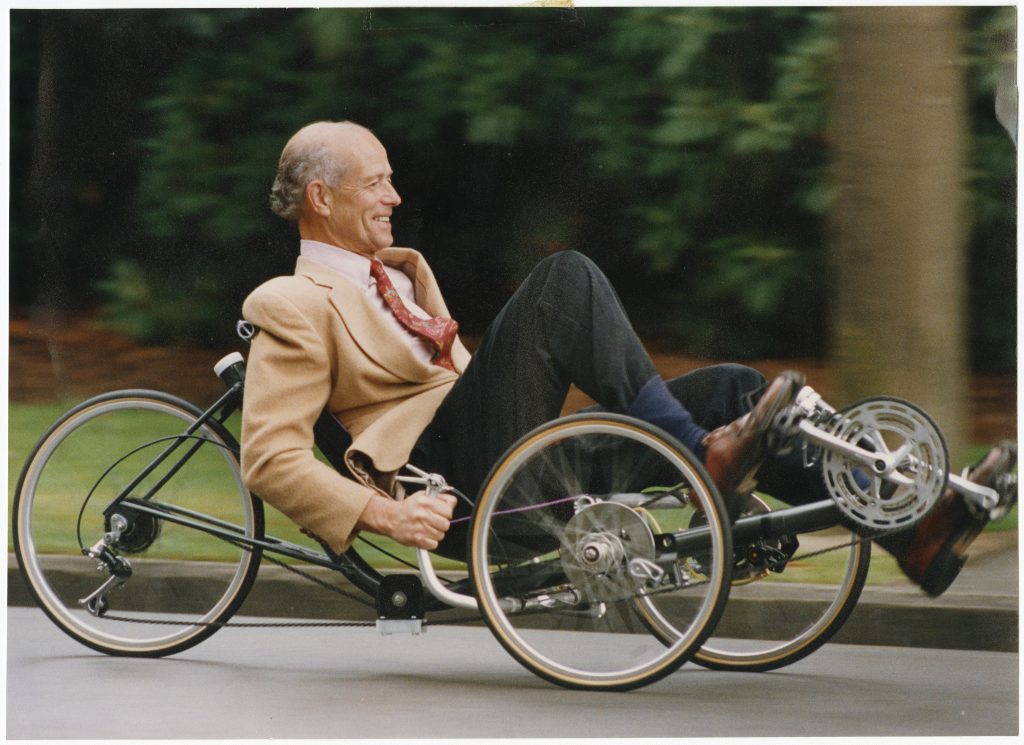
This was a project that started in 1985 and wrapped up in the 90’s and was run by John Raine. A tadpole trike platform was developed with four versions being produced and plans sold globally for people to build. The activities included: trialling some fairings; experimenting with motor-assists, both electric and internal combustion engine (5 kW Honda Beat engine taking it up to 85 km/h…); and energy efficiency of a practical commuting vehicle. Reports featured in the Human Power journal (1991 & 1994). In 1993, John Raine managed to organise an Erskine Fellowship for Professor David Gordon Wilson to visit.
Other
In 2021, a project was run to develop a electric assisted quadracycle for a local man with cerebral palsy. It got some national news coverage (item 1, item 2)
United Kingdom
Bath
London South Bank University – Aim93
Southampton
University of Liverpool Velocipede Team
United States of America
ASME HPVC series see’s a range of teams